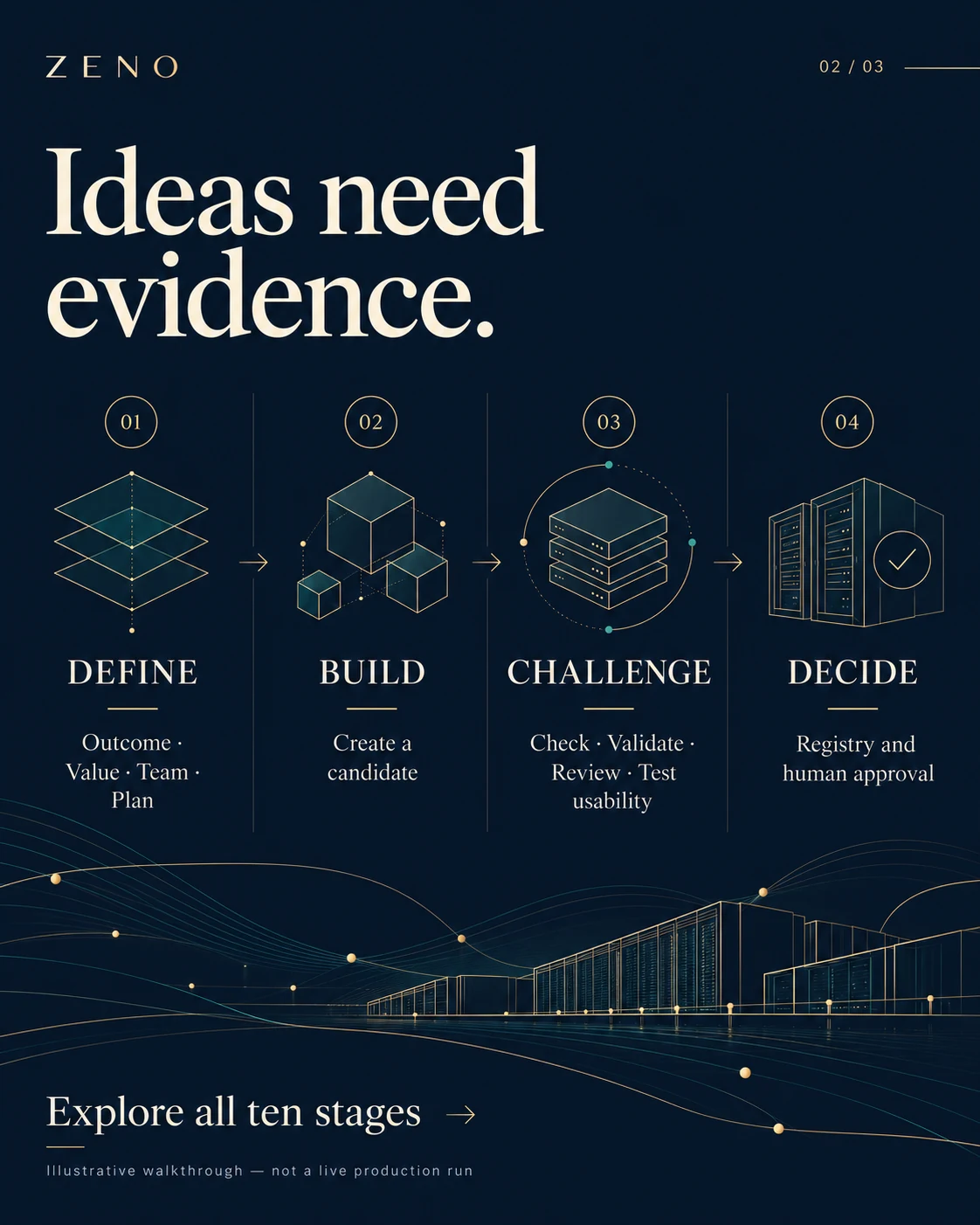
How do you turn a promising idea into something you would trust with real work? Follow one maintenance request through ZENO’s ten-stage Factory process. This is an illustration of the operating model, not a recording of a live run.
Autonomy has boundaries. People set the scope and can be asked to step in at any point where a decision needs their authority.
Define the workStages 1–4 · Agree the outcome, value, team and plan.
Build itStage 5 · Create a candidate people can inspect.
Challenge itStages 6–9 · Test, review and check usability.
DecideStage 10 · Record the human decision and its scope.
View the process illustrationAn illustrative summary, not a live production run. Use the ten-stage controls below to explore the complete walkthrough.
Ten stages. One example.
Choose any stage or press Play. A failed check sends work back for correction and another check; it does not earn a pass by moving to the next scene.
Read the ten stages below, in order.
01 / 10 · Outcome
Start with a question worth answering.
INF-21 is asked to organise an infrastructure maintenance request. The brief defines the information needed, the expected result and when a person must decide. Missing details remain questions, not invented facts.
Brief → team
Illustrative message: “The location is missing. Ask for clarification before planning.”
The intended outcome and acceptance criteria come first.
02 / 10 · Value trace
Explain why this work is worth doing.
The example asks whether a clearer request could reduce avoidable back-and-forth for a maintenance team. That is a benefit to measure, not a saving to announce before the work has been tested.
Team → planner
Illustrative message: “Compare the completeness of the request and the time spent clarifying it.”
A proposed benefit is not a proven customer result.
03 / 10 · Composition
Give each part a clear responsibility.
Choose the simplest suitable approach. In this example, preparing the request, checking it and deciding what may happen next are separate responsibilities. Connected components must mean the same thing by each field.
Coordinator → team
Illustrative message: “Prepare the request, then hand it to a separate checker.”
The builder does not independently approve its own work.
04 / 10 · Planning
Agree what can happen—and what must wait.
The plan sets the scope, dependencies and permitted work. INF-21 may prepare a request for review in this example. It cannot turn an unresolved date into a confirmed appointment or commit anyone to physical work.
Planner → builder
Illustrative message: “Keep uncertain dates visible. Ask a person before making a commitment.”
People can be asked to step in whenever their authority is needed.
05 / 10 · Build
Make something people can inspect.
The builder creates a candidate workflow and interface against the agreed brief. The handover includes the current version, its assumptions and its stated limits so another person can examine the work.
Builder → tester
Illustrative message: “Here is the candidate, including how it handles missing information.”
A working-looking screen is the start of examination, not approval.
06 / 10 · Quality checks
Challenge the happy path.
Separate checks examine quality, security and applicable requirements. In the example, conflicting dates were treated as certain. The finding goes back to the builder for correction.
Tester → builder
Illustrative message: “Rework: preserve the conflicting dates and ask for clarification.”
These scripted checks illustrate the process; they do not establish security or professional clearance.
07 / 10 · Runtime validation
Does the changed version do the job?
After correction, the current implementation must be run against the intended outcome. The example checks ordinary requests, missing information and conflicting dates again. A favorable result from an older version is not enough.
Tester → reviewer
Illustrative message: “The revised example keeps the conflict unresolved for human review.”
If the outcome still fails, return to the relevant work and repeat the checks.
08 / 10 · Independent review
Make the evidence open to challenge.
A separate reviewer compares the current version with the brief, check results and remaining limitations. The question is whether the evidence supports the proposed next step, including what is still unknown.
Reviewer → team
Illustrative message: “Show the current version, its check results and unresolved limits together.”
Separate review helps challenge assumptions; shared errors remain possible.
09 / 10 · Usability
Can a person understand and use it?
The example asks whether someone can distinguish missing details from confirmed information and see what they need to do next. Confusing labels or unclear handovers send the interface back for improvement.
User review → builder
Illustrative message: “Make the unresolved date and the next action easy to recognise.”
Usability must be tested with people; this illustration is not a user-acceptance result.
10 / 10 · Registry & approval
Keep the human decision visible.
The authorized decision maker reviews the evidence and decides whether to approve, request changes or stop. The decision, version and permitted scope are recorded. This illustration does not activate INF-21.
Decision maker → team
Illustrative message: “Request changes, stop, or approve within the authorized scope.”
Human approval can also be required earlier; it is not confined to the last stage.
Where this leads
A broader ambition. Practical starting points.
ZENO's longer direction is automation across the infrastructure lifecycle. The Factory approach supports that ambition by making work, checks and decisions reviewable. ZENO Zero brings practical tools and scoped services to market as a commercial starting point.
Our infrastructure lifecycle work reached a milestone with PCT/EP2026/072930, filed on 28 July 2026, claiming an earlier European priority. Filing is not a grant and does not validate this example's execution.